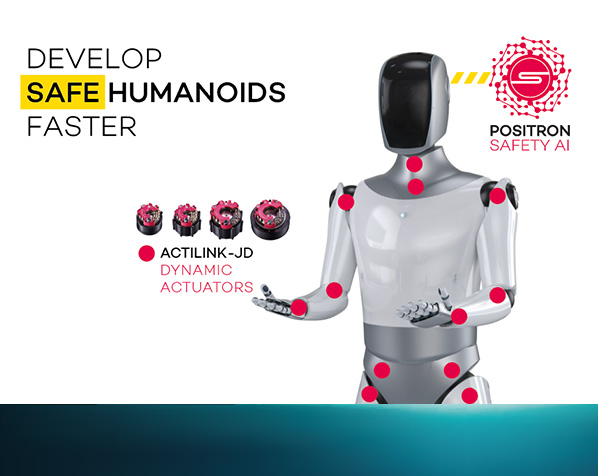
A high-density, all-in-one actuator series paired with the world's first three-tiered, certified functional safety architecture for humanoid robots — engineered for the moment legged platforms step out from behind the cage.
As humanoid robots enter logistics, manufacturing and healthcare, the engineering requirements shift fundamentally: joints must be compact, energy-efficient and dynamically capable enough to power a full human-scale body — and the robot must be demonstrably safe to operate alongside people without a physical cage. ACTILINK-JD with POSITRON Safety AI was designed specifically for this moment.
Each unit integrates a high-torque outrunner motor, a single-stage planetary gearbox, and a SOMANET Circulo servo drive into a single, self-contained joint — co-locating drive electronics and motor in a thermally optimised package that measurably extends battery runtime in untethered platforms.
A humanoid is an inherently unstable inverted pendulum — a sudden loss of power does not produce a safe stop, it produces an uncontrolled fall. POSITRON was designed from first principles to address this reality across three certified tiers.
Functional safety for humanoid robots requires solving problems that industrial robot standards were never written to address — an unstable platform that cannot be safely powered down, an AI-driven control stack that is probabilistic rather than deterministic, and a fall zone that moves with the robot.
The Circulo drive co-locates power electronics, feedback systems and functional safety logic inside the joint module itself — achieving torque densities up to 84.5 Nm/kg while distributing real-time safety monitoring across systems of 50+ degrees of freedom over FSoE. Each joint becomes an independent smart safety node.
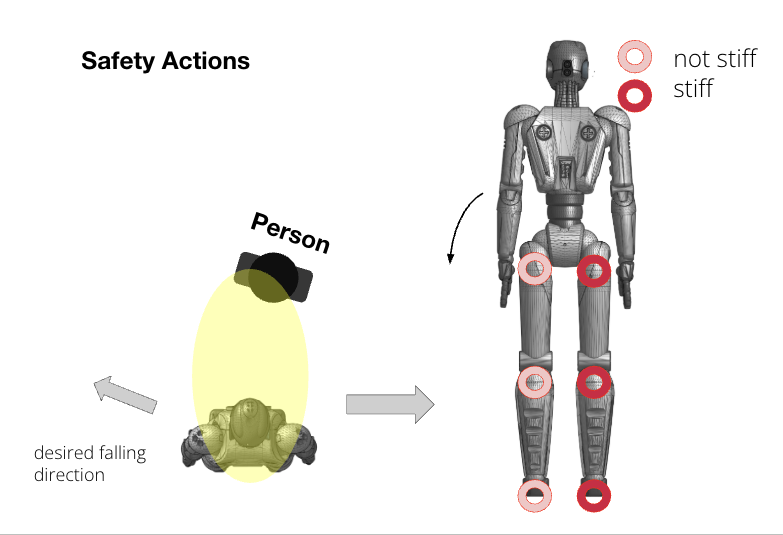
Safe Active Damping via Active Short Circuit of the motor windings creates a predictable electromagnetic braking effect across all joints simultaneously, allowing the robot to collapse in a controlled, directional manner. Certified at PLe (SIL3, Cat 3) under ISO 13849 — no equivalent in existing standards.
POSITRON introduces a formally defined fall-zone parameter Sf into the robot's separation distance calculation, a tipping-physics term derived from robot height and instantaneous velocity. Being proposed for inclusion in ISO/WD 25785-1.
An independent multimodal AI safety layer monitors the robot's operational AI in real time, providing semantic context awareness that no purely kinematic controller can offer. Aligned with ISO/IEC TR 5469 and ISO/IEC TS 22440 — the emerging frameworks for functional safety applied to AI.
Bolted-down industrial robots can be safely powered down. Humanoids cannot. POSITRON replaces the conventional Safe Torque Off response with a layered architecture that keeps the robot safe under fault — without cutting the power that keeps it upright.
Safe Active Damping via Active Short Circuit of the motor windings produces a predictable electromagnetic brake across all joints simultaneously. The robot collapses gradually and directionally — away from nearby humans — instead of free-falling.
A dynamically calculated fall zone integrated into the separation distance monitor. Extends ISO 10218-2:2025 with a tipping-physics term, ensuring the perimeter accounts for the ground area a tipping robot would impact — not just approach distance.
Independent multimodal supervision of the operational AI in real time — distinguishing contextually safe from unsafe behaviour, independent of the primary control stack. Bridges deterministic functional safety with the probabilistic reality of physical AI.
Implemented via Active Short Circuit of the motor windings, SAD creates a predictable electromagnetic braking effect across all joints simultaneously — a response rooted in the physics of the drive itself, executed deterministically over Fail-Safe over EtherCAT, and certified at PLe under ISO 13849.
Cuts drive power instantly. On a bipedal robot, an inverted pendulum with no control authority free-falls — uncontrolled, unpredictable.
Drives stay energised in a controlled way. Electromagnetic braking across every joint produces a gradual, directional collapse.
POSITRON introduces a formally defined fall-zone parameter into the robot's separation distance calculation — the first known application of formal functional safety mathematics to the instability characteristics of bipedal platforms. Being proposed for inclusion in ISO/WD 25785-1.
Built on Synapticon's SOMANET Circulo, ACTILINK-JD combines drive electronics, outrunner motor, planetary gearbox, encoder and SIL3 PLe functional safety into a single validated joint module — covering hip-to-wrist requirements across humanoid, six-legged and quadruped platforms.
| Module | Peak Torque | Torque Density | Typical Joint | Functional Safety | Communication |
|---|---|---|---|---|---|
| ACTILINK-JD 20 | 20 Nm | up to 84.5 Nm/kg | Wrist · Distal arm | SIL3 PLe · STO + SBC | FSoE / EtherCAT |
| ACTILINK-JD 45 | 45 Nm | up to 80 Nm/kg | Elbow · Forearm | SIL3 PLe · STO + SBC | FSoE / EtherCAT |
| ACTILINK-JD 75 | 75 Nm | up to 76 Nm/kg | Shoulder · Knee | SIL3 PLe · STO + SBC | FSoE / EtherCAT |
| ACTILINK-JD 110 | 110 Nm | up to 70 Nm/kg | Hip · Major locomotion | SIL3 PLe · STO + SBC | FSoE / EtherCAT |
A mechanically, electrically and safety-validated starting point. OEMs focus engineering resources on system-level design and AI rather than reinventing joint hardware from scratch. Single-source procurement of a pre-validated joint module measurably shortens the path from hardware delivery to a functional prototype.
The integrated drive-motor-gearbox design reduces per-joint wiring, connector count and assembly complexity across platforms with 30–50 actuators. FSoE carries motion and safety data on a single network, eliminating parallel wiring infrastructure. Savings compound at the system level — material toward series production.
Every ACTILINK-JD ships with SIL3 PLe certified safety functions; POSITRON is already certified at PLd and PLe. OEMs inherit a qualified functional safety foundation rather than qualifying each component independently — substantially reducing engineering effort and third-party audit costs.
Synapticon's functional safety engineers are active members of the standards committees currently drafting the next generation of humanoid safety regulations. POSITRON is built to comply with those emerging frameworks before they come into force.
ACTILINK-JD with POSITRON Safety AI launched 24 June 2025 — first deployments at Lenovo and ZJ.
10–100-unit proof-of-concept deployments across humanoid OEMs. Standards committee work intensifies.
Broader humanoid field deployment. Bill-of-materials decisions for serial production locked in.
Forthcoming humanoid safety standards take effect. Production runs of 1,000s–10,000s of units anticipated.
All materials provided with the original Innovation Award submission, consolidated for the jury at this single URL.
Specifications across all four ACTILINK-JD sizes, mechanical drawings, and integration guidance.
synapticon.com/products/actilink-jd → Product Page · POSITRON Safety AIFull description of Multi-Axis Safe Motion, Safe Human Detection and AI Behavioral Safety with certification scope.
synapticon.com/products/positron-safety → Video · Submitted with ApplicationPromotional video walking through Safe Active Damping, the fall zone, and AI behavioural supervision in action. Provided with submission.
POSITRON Safety AI.mp4 → Reference DocumentLenovo and ZJ Humanoid Robot reference notes — provided as supporting material with the original Innovation Award submission.
Synapticon References.pdf → Photo · InnovationStudio photography of the ACTILINK-JD joint module showing the integrated drive-motor-gearbox architecture.
ACTILINK-JD.png → Diagram · InnovationArchitecture diagram showing how ACTILINK-JD joints distribute the POSITRON functional safety stack across a humanoid platform.
ACTILINK - POSITRON Overview.png →